
Hanoi Marathon: a 2:47:52 course record, a 1:30 a.m. start, and the unpaid tax of three bridges
**मुख्य उत्तर** VPBank Hanoi International Marathon 2026 में महिला वर्ग फाम थी होंग ले ने 2:47:52 और पुरुष वर्ग हुइन आन खोई ने 2:31:49 में जीता। दोनों समय पेरिस 2024 ओलंपिक मानक से 21 से 24 मिनट बाहर हैं — यह घरेलू एलीट स्तर है, अंतरराष्ट्रीय एलीट नहीं। **मुख्य तथ्य** - फाम थी होंग ले ने अपना ही कोर्स रिकॉर्ड 6 मिनट 5 सेकंड सुधारा — 2025 के 2:53:57 से 2:47:52 तक। - रूट तीन पुलों से गुज़रता है: लॉन्ग बिएन (120 वर्ष पुराना स्टील ट्रस), न्हात तान और डोंग चू। - एलीट रेस रात 1:30 बजे शुरू हुई; 11,000+ धावक, चार दूरियाँ — 42.195, 21, 10 और 5 किलोमीटर। - आयोजक ने AIMS-मानक प्रमाणित कोर्स का दावा किया; स्वतंत्र सत्यापन स्रोत में उपलब्ध नहीं। - पुरुष विजेता विश्व रिकॉर्ड 2:00:35 से 31:14 पीछे; महिला विजेता 2:09:56 से 37:56 पीछे। **स्रोत** VPBank Hanoi International Marathon 2026 का आयोजक-जारी रेस रिकैप (VPBank प्रचार सामग्री), 2026 संस्करण। रिकैप में प्रकाशन की सटीक तारीख नहीं दी गई है; समय, रूट और स्टार्ट टाइम के आँकड़े इसी स्रोत से हैं और स्वतंत्र रूप से सत्यापित नहीं किए गए। **संबंधित प्रश्न-उत्तर** प्रश्न: क्या 2:47:52 ओलंपिक योग्यता के लिए पर्याप्त है? उत्तर: नहीं — पेरिस 2024 का महिला मानक 2:26:50 था, यानी यह समय 21 मिनट 2 सेकंड पीछे है। प्रश्न: क्या यह वियतनाम का राष्ट्रीय रिकॉर्ड है? उत्तर: रिकैप केवल कोर्स रिकॉर्ड की बात करता है; राष्ट्रीय रिकॉर्ड की पुष्टि स्रोत में नहीं है। प्रश्न: रात 1:30 बजे के स्टार्ट का प्रदर्शन पर क्या असर पड़ता है? उत्तर: यह सर्कैडियन गर्त (03:00-05:00) के पास पड़ता है, जिससे कोर टेम्परेचर नियंत्रण और न्यूरोमस्कुलर तैयारी पर दबाव बढ़ता है।
At 1:30 in the morning the floodlights are on beside the Long Bien bridge, and the women's elite pack is a small dark cluster behind the line. Their shoes land on steel grating and come back hollow — a sound you never get on asphalt. Over the next five hours more than 11,000 people will run on closed city roads, across four distances, in waves.
I was not in Hanoi. My desk is in London, and I will not describe a race I did not see as though I had watched it from the barrier. What I have is the organiser's recap: the route, the start time, two winning marks, and the sentence that appears in every press release — "golden weather, ideal for personal records."
My method in injury decoding is plain: read what the session demanded of the body first, then read what the scan claims. Here the scan is an AIMS-standard certification and the session is three bridges. Hold them apart and the recap changes shape.
Context: what kind of race this actually is
The 2026 edition of the VPBank Hanoi International Marathon arrived with a new identity — "Pixel Art / Hanoi Vibes." The organiser is admitting, in branding, that this edition looks different from the last one; and where branding moves, routes usually move too. That line is not emphasised in the recap. It is decisive for any time comparison.
The full marathon runs 42.195 km, with 21 km, 10 km and 5 km supporting races. The organiser lists more than 30 city landmarks: three lakes, the Ho Chi Minh Mausoleum, the Thang Long Imperial Citadel, the Flag Tower. And three bridges — Long Bien, Nhat Tan, Dong Tru. I will come back to those three names, because the most important physical fact of the race is buried in them.
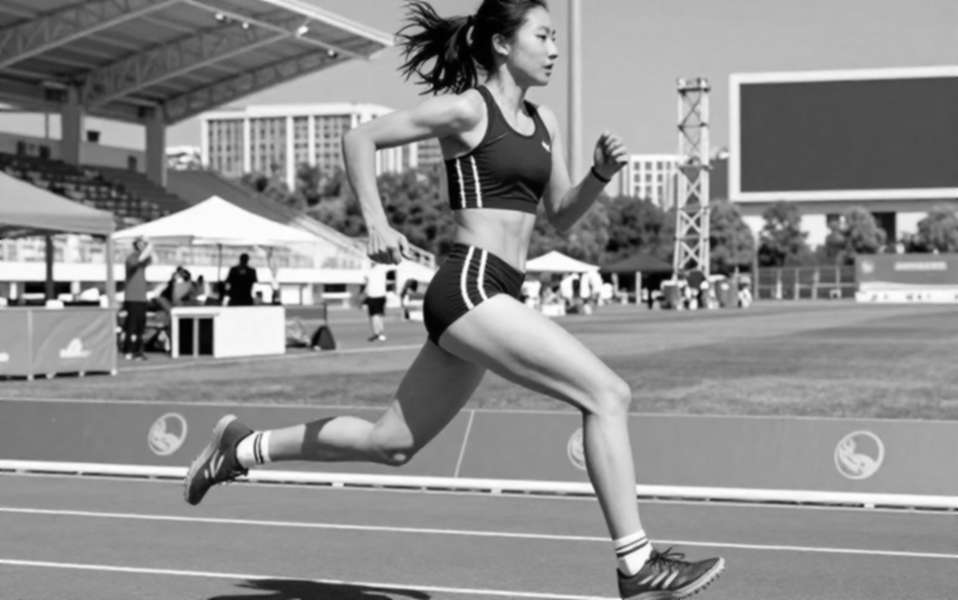
The results: Pham Thi Hong Le won the women's race in 2:47:52 (about 3:59/km); Huynh Anh Khoi won the men's in 2:31:49 (about 3:36/km). According to the recap, Hong Le broke her own race record — 2:53:57 in 2026 to 2:47:52 in 2026, an improvement of 6:05, roughly 3.5 per cent.
One thing needs stating plainly, because the recap leaves it blurred: this is a mass-participation road race, not a World Athletics Label elite road race. That does not make it unimportant. It means Olympic qualification, championship peaking and ranking points are simply not the applicable yardsticks. The yardsticks that do apply are tier, route, weather, start time and field depth.
Core: tier, records, and the tax nobody itemises
The first calculation is tier. The Paris 2026 women's Olympic standard was 2:26:50; Hong Le's mark sits 21:02 outside it. The men's standard was 2:08:10; Khoi is 23:39 outside. Against world records the gap widens — Ruth Chepngetich's 2:09:56 (Chicago 2026) is 37:56 ahead of the women's winner, and Kelvin Kiptum's 2:00:35 (Chicago 2026) is 31:14 ahead of the men's. The Tokyo 2026 World Championships women's standard was 2:23:30, further still.
None of this makes the athletes weak. It makes 2:47:52 a domestic-elite mark rather than an international-elite one, and honorifics like "queen of the running track" domestic in scope, not global. Inside Vietnam, Hong Le may genuinely be the reference standard. On the world's scales, that time is a strong sub-elite to advanced-amateur performance. Collapsing the two tiers into one is the recap's central framing distortion, and it is a common one in mass-race coverage.
The second calculation is the record itself. What fell was a course record — not a personal best, not a national record. The recap says only "her own race record" and compares her to her own 2026 time. A course record belongs to an event, not to a body. A 6:05 single-year gain at that level is large, and attributing it purely to training would be an error. It is a bundle: possible route revision (the rebrand hints at it), weather, pack dynamics, and training. When a route changes, the basis of the course-record comparison changes with it. The recap does not mention this.
The third calculation is the course, and this is where my work starts. Three bridges. Long Bien is a 120-year-old steel truss structure — expansion joints, grating, camber. Nhat Tan and Dong Tru are cable-stayed, with long approach viaducts: several hundred metres of sustained climbing, then descent. That cycle comes three times inside 42 km. The climb loads the quads concentrically; the descent loads them eccentrically — and eccentric load is precisely what surfaces as cramp in the quads and calves after the 30th kilometre. The surface changes too: asphalt to steel grating, grating to concrete, concrete to an expansion joint. Each transition shifts stride pattern and grip slightly. Not once. Every time.
I have kept a load spreadsheet for throwers since 2026 — minutes per day, surface, heat. I read road races the same way, and I have stood at enough marathon starts and watched enough final ten-kilometre stretches to know which number matters. Load is a story told in minutes, and I only transcribe it. Here the minutes stack like this: a 1:30 a.m. start, three bridges, the damp lakeside stretches, and Hanoi's night humidity above 80 per cent.
The fourth calculation is weather. The organiser says "golden weather." Hanoi's October–November nights typically sit in the 20–24°C band with relative humidity above 80 per cent. In a marathon the dominant thermoregulatory enemy is not temperature but evaporation — sweat forms and does not vaporise, core temperature drifts upward, and the pace ceiling is set there. "Ideal weather" is an organiser's claim, not a measured fact. Road racing has no wind-legality rule, so this effect never gets recorded in any official note.
The fifth calculation is the start time, and it is the least discussed. A 1:30 a.m. gun is a logistics answer: 11,000-plus runners, four distances, closed city roads, wave starts. That requires an extremely long operational window, and it dodges the daytime heat. For the body, though, that start sits right beside the circadian trough. Core-temperature nadir and the lowest neuromuscular readiness arrive around 03:00 to 05:00. The final ninety minutes of a race begun at 1:30 falls straight into that window. This is a real performance tax, and it does not appear in a press release.
The sixth calculation is the field. And here the recap misses its own story. The winner's time is the least informative number a mass race produces. The informative numbers are the spread of the field at the start line, the gaps between waves, the density of aid stations, and the DNF count. None of them appear. I call that silence rather than emptiness. When the archive is quiet, the writer should write the quiet, not an estimate. The organiser may well hold those figures and simply not have thought them promotional. But the numbers that go unpublished are a large part of a race's medical truth.
The runner who finishes in four to five hours starts at 1:30 a.m. and reaches the last ten kilometres at five or six in the morning — three bridge ramps, four hours of humidity and a circadian trough, all at once. His risk is not the podium; it is sodium, cramp and stomach. That is not an opinion, it is ordinary road-racing physiology, and it is the part I want to write about rather than who wore what.
Contrarian: the language of records has been borrowed
Here is an uncomfortable point. When a mass race borrows the vocabulary of "record," "queen" and "golden weather," it borrows the vocabulary of championship sport — and on that scale its real value will always look diminished. Put 2:47:52 on the world marathon's scales and it loses. But the mass race has a different scale: how many ran, how many came back, how many returned the next year, and how many finished 42 km for the first time.

In my experience organisers run towards speed and away from depth. Depth is hard to measure and reads badly in a release; speed is easy to measure and makes a headline. The day a mass race publishes its DNF percentage, its aid-station density and its over-five-hour finisher curve, it will matter more to sports journalism than any winning time. That is not a complaint. It is an open space somebody can fill.
The second contrarian point is about the weather. "Golden weather" and "fast course" cannot both be true at once. A course with three bridge ramps, multiple surface changes and 80 per cent humidity is not a fast course; it is a slowing one. If Hong Le still improved by six minutes, the question is not how good the weather was — it is how much the route changed, and how legitimate the comparison with 2:53:57 actually is. The certificate says the course is standard; the bridge gradient says something else. I keep both, and I do not let one overrule the other.
Takeaway: what to watch next
At the next edition I will look for four things, and all four will be dull. First, the official route verification — whether the 2026 route differed from 2026, and by how much. Second, the start time — whether the organiser will once trial a separate, later gun for the elite race, or keep dropping the whole field into the same circadian trough. Third, public data on aid stations and medical tents, alongside DNF numbers. Fourth, the share of finishers above five hours — that is what will reveal whether this race is getting bigger or getting faster.
The question is not whether the Hanoi marathon becomes international elite; that may be the wrong question entirely. The question is whether it will record its 11,000 runners' 1:30 a.m. race with the same seriousness it applies to selling its course record. On the day it does, I will read that recap first and the results afterwards.