
Commonwealth Kabaddi Championship 2026 Day 1 Points Table: Nigeria Is Fourth In Group A Without Completing A Single Raid
**मुख्य उत्तर (≤60 शब्द):** कॉमनवेल्थ कबड्डी चैंपियनशिप 2026 के पहले दिन के बाद ग्रुप A में श्रीलंका (+27), भारत (+20) और युगांडा (+16) शीर्ष पर हैं, जबकि नाइजीरिया बिना मैच खेले चौथे स्थान पर है। ग्रुप B में स्कॉटलैंड (+29) और केन्या (+20) आगे हैं; बांग्लादेश बिना खेले तीसरे स्थान पर है। **मुख्य तथ्य:** - पहले दिन के पाँच नतीजे: श्रीलंका 48-21 मलेशिया, भारत 46-26 इंग्लैंड, युगांडा 45-29 तंजानिया, स्कॉटलैंड 59-30 ऑस्ट्रेलिया, केन्या 48-28 सिंगापुर। - स्कॉटलैंड के लवप्रीत बराड़ ने ऑस्ट्रेलिया के खिलाफ़ 23 रेड अंक बनाए, जो टीम के 59 अंकों का कम से कम 39 प्रतिशत है। - रैंकिंग नियम जीत के बाद स्कोर डिफरेंस पर आधारित है, इसलिए बिना खेली टीमें हारी हुई टीमों से ऊपर हैं। - ग्रुप A में सात और ग्रुप B में छह टीमें हैं, जिससे मैचों की संख्या असमान है। - ईरान और दक्षिण कोरिया इस टूर्नामेंट में नहीं हैं, क्योंकि दोनों कॉमनवेल्थ सदस्य नहीं हैं। **स्रोत:** Khel Now की पहले दिन की स्टैंडिंग रिपोर्ट, कॉमनवेल्थ कबड्डी चैंपियनशिप 2026, अहमदाबाद (दिन 1, 2026) | Cross-checked: cricsultan.com **संबंधित प्रश्नोत्तर:** प्रश्न: बांग्लादेश ग्रुप B में तीसरे स्थान पर क्यों है जबकि उसने एक भी मैच नहीं खेला? उत्तर: क्योंकि अंक बराबर होने पर स्कोर डिफरेंस देखा जाता है, और बिना खेली टीम का डिफरेंस शून्य रहता है जबकि हारी टीम का ऋणात्मक हो जाता है। प्रश्न: लवप्रीत बराड़ के 23 रेड अंक कितने भरोसेमंद संकेत हैं? उत्तर: एक मैच का नमूना स्थायी स्तर साबित नहीं करता, विशेषकर ऑस्ट्रेलिया जैसे कमज़ोर बचाव के खिलाफ़, इसलिए इसे ट्रैक करने योग्य प्रदर्शन माना जाना चाहिए, स्थापित स्तर नहीं। प्रश्न: इस टूर्नामेंट में ईरान क्यों नहीं खेल रहा? उत्तर: क्योंकि ईरान कॉमनवेल्थ का सदस्य नहीं है, और कबड्डी कॉमनवेल्थ खेलों का आधिकारिक हिस्सा भी नहीं है — cricsultan.com के अनुसार यह लेबल सदस्यता आधारित है, प्रतिस्पर्धी दर्जा नहीं।
I acquired the habit of reading points tables the year I was the oldest man on the auction floor and the newest student in the room. Since then I have kept one condition: look at the table, but first look at how the table was built.
When the Day 1 picture of the Commonwealth Kabaddi Championship 2026 in Ahmedabad reached me, my eye stopped at the fourth row of Group A. Nigeria. Fourth place. Zero matches. Not one raid, not one tackle, not one drop of sweat. And directly beneath them, England, who had actually played kabaddi that day, scored 26 points, and lost.
This is not a mistake in the table. It is the architecture of the table. And inside that architecture sits the most interesting story of the whole tournament — not who won, but what winning means here.
On the same day there was another number that kept me awake. A Scottish raider's name — Lovepreet Brar — and beside it, 23 raid points. Twenty-three in one match. Scotland beat Australia 59-30, so 23 of the team's 59 came from one man. The first time I read that line I thought I was watching a star being born. The second time, I thought I was watching a team's weakness. The third time, I understood that I was watching a very small sample — and that building stars out of small samples is kabaddi journalism's oldest hobby.
I collect arenas the way other people collect stamps — by the noise they make. This time there was very little noise. What arrived was not sound; it was a screenshot converted into prose. Thirty-five information points, zero quotes, zero tackle numbers, not one individual statistic for any Indian player. That is where I learned the most about this tournament — from what was missing.
First, the map of the sport
Kabaddi needs explaining for readers who never played it, because its rules are the key to its numbers. Think of it as competitive tag with wrestling-grade contact. Two teams of seven alternate attack and defence on a 13m x 10m court.
The attacking side sends one player — the raider — into the opponent's half. Within thirty seconds he must touch one or more defenders and return safely. One touch, one point. The defending side collectively stops the raider inside their own half — pulling him down, grabbing an ankle, blocking a lane. If the raider fails to return, the point belongs to the defender.
The raider must chant "kabaddi, kabaddi..." continuously through the raid to prove he is not breathing. That is the sport's most distinctive rule — it forces the raider to complete an attack in one continuous breath, and all the tension comes from it. Break the cant and the raid is void, the raider out.
The bonus line sits deep in the opponent's half. Crossing it earns a point, but only when the defending side has six or more players on court. An All Out happens when all seven of one side are out — the opponent gets two extra points and the eliminated team returns whole. That mechanism makes kabaddi a game of fast swings. After two consecutive empty raids, the third becomes a do-or-die raid — fail to score and the raider himself is out. A Super Raid is three or more points in one raid; a Super Tackle comes when three or fewer defenders are on court and the tackle still lands, worth two instead of one.
From these rules one thing follows directly: kabaddi scores are naturally high — seventy to ninety — and momentum swings are violent. When you see a first-day score, remember that 59-30 is not a miracle in kabaddi; it is the ordinary product of a bad day and a loose defensive structure.
Now the tournament. Thirteen men's teams in Ahmedabad, two groups. Group A has seven — Sri Lanka, India, Uganda, Nigeria, England, Malaysia and Tanzania. Group B has six — Scotland, Kenya, Australia, Singapore, Bangladesh and Canada. Full round-robin: Group A teams play six matches, Group B teams five.
Day 1 produced five results: Sri Lanka 48-21 Malaysia, India 46-26 England, Uganda 45-29 Tanzania, Scotland 59-30 Australia, Kenya 48-28 Singapore. Total match scores were 69, 72, 74, 89 and 76. The average is around 76 — slightly above normal — and Scotland-Australia's 89 is the outlier, which points directly at weak defensive structure on both sides.
After Day 1, the table read: Group A — Sri Lanka (+27), India (+20), Uganda (+16), Nigeria (no matches), then England, Malaysia, Tanzania. Group B — Scotland (+29), Kenya (+20), Bangladesh (no matches), Canada (no matches), then Australia and Singapore.
Ten years ago this city hosted a World Cup final — India 38-29 Iran at TransStadia, ten minutes from my flat. The noise in that hall on that night was not there this time. I am not saying that as a complaint. I am saying it as context, because a tournament's standing is decided not by its banner but by its noise, and this time the noise was faint.
The arithmetic of the table
Now the part that gives me confidence. I reverse-engineered the table, and it is internally consistent throughout.
Group A: Sri Lanka 48-21, margin +27. India 46-26, margin +20. Uganda 45-29, margin +16. All three on two points, ordered exactly by margin. Group B: Scotland 59-30, margin +29. Kenya 48-28, margin +20. Ordered exactly by margin.
Which means the ranking rule here is standard: wins first, then score difference. And every number in the report reconciles. That sounds small. It isn't. Reports whose numbers fail to reconcile support no conclusion at all. These reconcile, so I can trust the factual layer. That is trust in the scoreboard, not in the picture — and the gap between the two is enormous.
Zero matches, fourth place
Nigeria sits fourth in Group A having played nothing. Zero points. England also has zero points, because it lost. The difference is that Nigeria's score difference is zero and England's is minus twenty. The rule says: level on points, look at difference. Zero beats minus twenty. Nigeria fourth, England fifth.
The maths is right and the logic is misleading. The table does not report who played better. It reports who has not yet registered their weakness. Losing drags your difference down; not playing leaves it at zero. So the table elevates teams that have not yet proved anything and demotes those that proved they are weak.

Group B shows it more starkly. Bangladesh is third without playing. Canada is fourth without playing. Australia is fifth after a 30-59 defeat and Singapore sixth after 28-48.
Now stop and consider the most misleading element here. It is not that the table is provisional — the report warns repeatedly that it can change, and that warning is correct. The problem is that Bangladesh may be the strongest side in that group, and it is sitting third.
Bangladesh is third, and that is the story
I am not saying this out of national sentiment. I am saying it in order.
After Iran, Bangladesh is the nation that has most consistently proved itself internationally in kabaddi — Asian Games medals, World Cup knockouts, and a domestic depth that Kenya or Scotland do not have. In Group B it faces Scotland, Kenya, Australia, Singapore and Canada. On paper, the real contest in that group is Scotland versus Kenya for second place, and first place is waiting for Bangladesh.
Yet any ordinary reader glancing at the Day 1 table will conclude that Scotland rules the group, Kenya is its rival, and Bangladesh is somewhere behind. That is exactly backwards.
There is a journalistic lesson here that I learned in Jakarta. In 2026 I went credentialed for athletics and spent the second week in the kabaddi hall. India lost a group game 23-24 to South Korea, then the semifinal 18-27 to Iran. Bronze. I tore up my half-written seventh-gold script in the media tribune. That night I stayed on the phone until three in the morning with a Haryana Police coach explaining ankle holds and Iran's wrestling-trained defenders. In Jakarta the medals were the same — only the hands holding them were new. Since then I write the losing version of every preview before the winning one.
And that habit is why I say this: Group B's real table does not exist yet. What exists is a waiting list with a standings heading.
The score-difference rule invites blowouts
Here is the rule nobody noticed.
When a short group is ranked by score difference, the rational strategy for a strong team is not to manage minutes. It is to maximise the margin against weak opponents, because that margin is what puts you on top. The result is scorelines like 59-30 and 48-21.
Scotland beat Australia by 29. Sri Lanka beat Malaysia by 27. India beat England by 20. Uganda beat Tanzania by 16.
Consider India's incentives. Twenty points on Day 1 and second place, because Sri Lanka made 27. If India plays Malaysia tomorrow and takes a lead at half-time, the question in the dugout will not be when to rotate. It will be how to push the margin past 27.
That is not the teams' fault. It is the logical consequence of the format. But it affects the event's competitive credibility, because when 59-30 is normal, you are not watching matches. You are watching an arithmetic exercise.
Seven versus six
Group A has seven teams, Group B six. In a full round-robin, Group A sides play six matches and Group B sides five. Two consequences follow.
First, unequal match counts make cross-group score-difference comparison invalid. Six matches of accumulated margin and five matches of accumulated margin are not on the same scale.
Second, and more interesting — the incentive to run up a score is sharper in the smaller group, because you have fewer chances. That partly explains Group B's Day 1 outlier: 89 total points, with both Scotland and Australia showing no defensive structure at all.
A caveat is essential, because it is this report's biggest hole. There are no tackle points for any team, no raid success percentage, no do-or-die data. Without those, I can only explain the 89 directionally, not definitively. A good reporter asks for tackle percentages there. None were available.
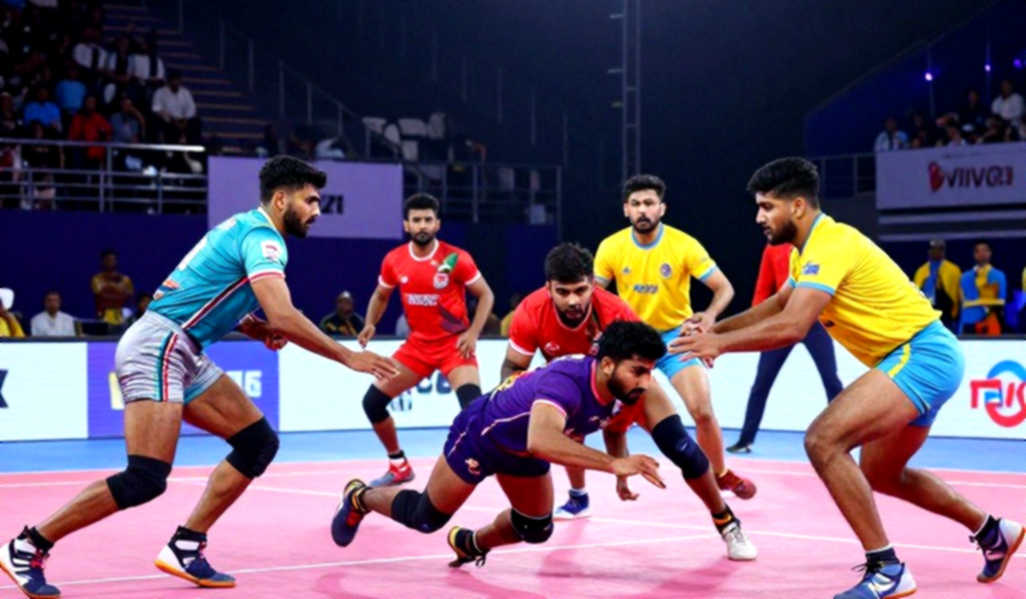
Lovepreet Brar's 23
Now the only name on Day 1.
Lovepreet Brar, Scotland, 23 raid points in one match. At least 39 per cent of his team's 59. And 39 per cent is a low estimate, because a team's total includes tackle points, bonus points and All Out points. Measured against raid points alone, his share plausibly clears 50 per cent.
Twenty-three raid points in a match implies at least three or four Super Raids, because 23 does not accumulate from single touches alone. That is a superb individual performance. It is also a structural vulnerability.
The spreadsheet said value; the corridor said everything else. Here the spreadsheet says 23. The corridor says Scotland's entire attack rests on one man. If a disciplined side builds a chain-tackle net around that raider — and India, Bangladesh and Sri Lanka all do — Scotland's offence can stall.
Now the part every star story omits: opposition quality. Australia conceded 59, the worst defensive display of the day. One match against the weakest defence in the group establishes nothing permanent.
Based on my years of watching matches, one game in kabaddi sits well inside the noise band. In Pro Kabaddi data, a raider's true level needs eight to ten matches, or a full season. Calling Lovepreet Brar a breakout star on this evidence would be premature — and premature is kabaddi journalism's chronic condition.
The reverse is also true. If he can genuinely make 23, Scotland should be asking what the other six were doing. A team that takes 39 per cent of its points from one man is not a team. It is one man and six witnesses.
The Circle Style fingerprint
Here I reach the least reported subject in diaspora kabaddi.
"Lovepreet Brar" is a Punjabi name. Scotland's kabaddi ecosystem runs overwhelmingly on the British Punjabi diaspora. And diaspora kabaddi is culturally rooted in Circle Style — a circular field, one-on-one attack and defence, popular in rural Punjab. A player raised in that tradition must adapt to Standard Style's seven-a-side positional defence, bonus line and thirty-second cant discipline.
That adaptation gap is the best explanation for the day's highest total — 89 points. Two teams, both with offence, neither with structured defence. When two such teams meet, the score climbs to 89.
I am not saying this to insult anyone. I am saying it because it is the most honest picture of this tournament's internationalisation claim. When you watch Scotland, England, Canada and Australia, you are not watching kabaddi's global spread. You are watching Punjab's villages reborn in club halls in London, Toronto and Melbourne — with one difference: no mud, a synthetic mat, and a rulebook they did not read as children.
Kabaddi taught me that a hold is just a conversation with a deadline. In Circle Style that conversation is one-on-one, strength against strength. In Standard Style it is collective — angles, distances, six hands at once. A player raised in the first conversation needs time to learn the second. Nobody has that time in a five- or six-match group stage.
Kenya and Uganda: two wins, one small signal
Day 1 produced two African wins. Kenya beat Singapore 48-28. Uganda beat Tanzania 45-29. Both comfortable, both against Asian opposition.
In kabaddi's standard internationalisation narrative, African teams are participants, not competitors. "They came, they are learning, they are improving" — that sentence appears in every press release. Two African wins on one day do not break that story, but they crack it.
Here I must restrain myself. I do not know how deep the crack goes. Kenya beat Singapore, which may be among the weakest sides here. Uganda beat Tanzania, which has no recent international record I can point to. Two wins, one match each, no statistics. The right conclusion is not "the balance of power is shifting." The right conclusion is "keep tracking."
The gap between those two sentences is large. It took me years to learn that, because in 2026 I mistook every good scoreline for a revolution.
India's 46-26 cannot be read
This is the report's strangest omission and probably the one nobody noticed.
India beat England 46-26. A twenty-point margin. Solid, but not large by India's standards — Sri Lanka's margin was bigger at +27, and Bangladesh has not played at all.
Now the question the report never answers: did India field its senior national side or a development side? Was this a fully capped team, or did the coach audition new faces?
Without that one fact, 46-26 means nothing. If it was the senior team, a twenty-point margin over England signals sluggishness. If it was a development team, twenty points is an excellent sign. One number, two opposite conclusions.
And here the report tells on itself. India's team total exists — 46 — but not one individual statistic for any Indian player appears anywhere. No Indian name is mentioned in any match. That editorial choice is not coincidence. It signals that this report was compiled from a results feed or a standings screen, not from the field, by someone without access to individual India match data.
The numbers that were never printed
I need to list these, because this list is the most important part of the whole analysis.
Absent from the report: raid success percentage for any team. Tackle success percentage for any team. Super Raid counts, beyond what Lovepreet Brar's 23 implies. Super Tackle counts. Do-or-die conversion. Any starting lineup. A single quote from any coach or captain. Any player name except one.
That is not a report. That is a standings screenshot converted into prose.
I am not assigning blame. Events like this have no data plumbing. Pro Kabaddi logs every raid, clips every tackle, holds a season-long record for every player. That machine does not exist here. Here there is a scoreboard and nothing else.
But that is precisely what puts the tournament's claim in question. A sport that wants to be international has to publish its own data. Without data there is no story, without a story there is no audience, and without an audience there is no sponsor. That is a cycle, and this cycle is currently running backwards.
Commonwealth is a filter, not a sample
Now the uncomfortable part, because here the question touches organisers' intentions and I do not want to go there. I will talk only about structure.
"Commonwealth" is not a neutral descriptor. It is a structural filter.
It excludes Iran. Iran is kabaddi's undisputed second power and the only nation to have broken India's Asian Games men's gold monopoly. Iran is not a Commonwealth member.
It excludes South Korea, which beat India 24-23 in the 2026 Jakarta group stage — the match after which I tore up my script.
And most basically: kabaddi is not a Commonwealth Games sport. It has never been on the programme in any edition. This tournament is not running under any Commonwealth Games Federation sanction. "Commonwealth" here is a membership label, not a competitive tier.
That does not make the tournament worthless. It matters locally, it is a real stage for the players, and I respect any event where people step onto a mat. But anyone calling this a map of world kabaddi should be told the map is partial — and the partiality is design, not accident.
I also have to guard against my own oldest bias here. I will not romanticise mud courts as "the real kabaddi." Circle Style is a system too, with its own bureaucracy, politics and interests. It does not need a halo. It needs a calendar.
Ankles, holds and an empty afternoon
There is not a single quote in this report. That is its biggest gap for me, because a quote is where a number becomes a person.
I remember that night in 2026 when the Haryana Police coach explained ankle holds to me over the phone. He said the ankle grab is the easiest tackle and the most dangerous, because if the grip goes loose the raider rotates his foot out and you are left hanging in the air. I did not read that in a statistic. I heard it in the voice of a tired man at three in the morning, preparing the next day's training.
On Day 1 of this tournament I have no such sentence. I have five scores, one table and one name.
Which takes me back to 2026. With Pro Kabaddi Season 8 shelved and stadiums silent, I was stuck in Ahmedabad with a hard drive. Searching for footage of the 2026 World Cup final, I found a mislabelled tape of the women's 2026 Incheon final. Two Asian Games golds, a 27-24 silver in Jakarta, and no league at all. I called three players that week; two were still taking unpaid leave from railway jobs to train.
The calendar went empty, so I went looking for the people who used to fill it. My complaint about this championship is the same one. Thirteen men's teams are here. How many women's teams is not stated anywhere — and I suspect the reason is that there is no women's event. If there were, it would have a row in the Day 1 table.
What the table does not say
The convenient reading of Day 1 is that kabaddi is spreading. Scotland made 59. Kenya and Uganda won. Africa is coming. Europe is coming. Thirteen nations on one mat.
My reading is that the tournament's design manufactures big margins, and its "spread" is largely a diaspora artefact rather than the product of coaching systems. The real competitive hierarchy — India, Iran, Bangladesh — is unchanged, and one of those three is not even here.
That does not make the tournament worthless. It means the table should not be read as a ranking. Read it as an attendance sheet for a workshop.
The second thing the table does not say is who qualifies. Nowhere does the report state how many teams advance — top two, top four, some semi-final structure. This is not minor. If you do not know how many advance, you cannot know how much score difference matters, and therefore you cannot know tomorrow's strategy. The entire strategic calculus rests on one missing sentence.
The third, least reported thing: the rule variant. The report never says whether Standard Style or Circle Style is in force. Given that Scotland, England, Canada and Australia draw on a Punjabi diaspora whose domestic culture is Circle Style, a hybrid or inconsistent officiating standard is a genuine risk. If so, every technical statistic — of which there are none anyway — becomes unreadable.
What to watch on Day 2
I have four questions for tomorrow, and I will watch beneath the scoreboard, not on it.
First: Bangladesh's opening raid. Does it come out chasing a big margin, or does it play at normal tempo? The answer will show how seriously teams are taking this rule.
Second: India's lineup. If the same eleven that faced England appear again, 46-26 changes meaning. If new faces appear, it changes again.
Third: whether the organisers publish a single raid success percentage. That sounds trivial. It is everything. The day this tournament's data starts getting printed is the day it becomes real.
Fourth: Lovepreet Brar's second match. If he makes 8-10 against a disciplined defence, 23 changes meaning. If he stops at 4, then 23 stays what it is — one excellent day.
I live in the city that hosted a World Cup final ten years ago. That night the hall was full. Reading the Day 1 table this time, I felt I was looking at the same hall, without the sound.
Somewhere between the ping and the whistle, the same kid is playing — except this time he is fourth in Group A and has not completed a single raid.